Testing Machine in Factory
We are pleased to announce the successful completion of in-house testing for our latest twinscrew extruder and cutting machine for our client.
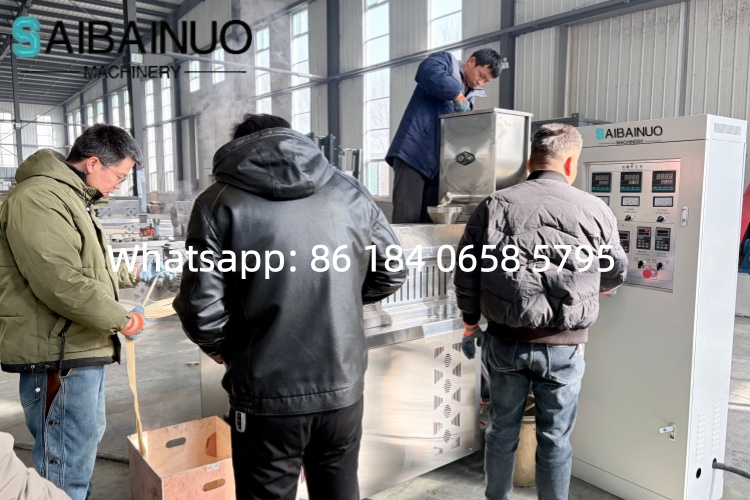
During the test, both machines operated seamlessly under simulated real-world conditions, meeting all designed performance benchmarks. The twin screw extruder demonstrated exceptional efficiency and stability, while the cutting machine achieved precise, consistent results, reaffirming the robustness of our engineering and quality control processes.
This achievement brings us one step closer to the final production stage, and we are excited to share these positive results with our valued client. And waiting for our client to come to our factory to talk about the specific requirement, customization options of this project in detail.
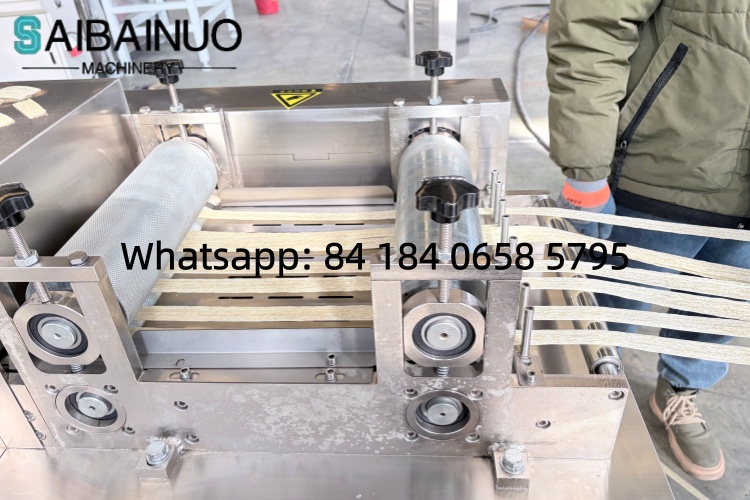
The twin-screw extruder is a highly versatile and efficient piece of industrial processing equipment used primarily for compounding, mixing, reacting, and devolatilizing polymeric materials. Its unique design and operational flexibility make it the machine of choice for a wide range of industries, including plastics, food, pharmaceuticals, and chemicals.
At its heart, a twin-screw extruder consists of two intermeshing or non-intermeshing screws rotating inside a barrel. Material is fed through a hopper, conveyed, melted, mixed, and pressurized by the co-rotating screws before being forced through a die to create a uniform product (e.g., pellets, sheets, or profiles).
This achievement brings us one step closer to the final production stage, and we are excited to share these positive results with our valued client. And waiting for our client to come to our factory to talk about the specific requirement, customization options of this project in detail.
The twin-screw extruder is a highly versatile and efficient piece of industrial processing equipment used primarily for compounding, mixing, reacting, and devolatilizing polymeric materials. Its unique design and operational flexibility make it the machine of choice for a wide range of industries, including plastics, food, pharmaceuticals, and chemicals.
At its heart, a twin-screw extruder consists of two intermeshing or non-intermeshing screws rotating inside a barrel. Material is fed through a hopper, conveyed, melted, mixed, and pressurized by the co-rotating screws before being forced through a die to create a uniform product (e.g., pellets, sheets, or profiles).


